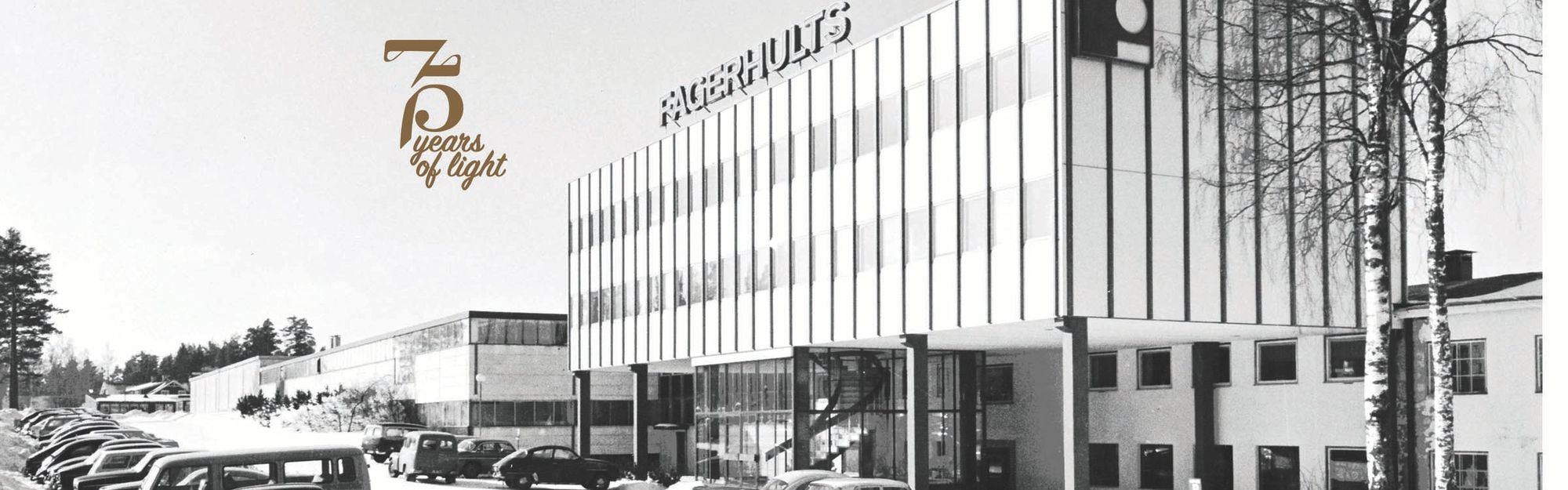
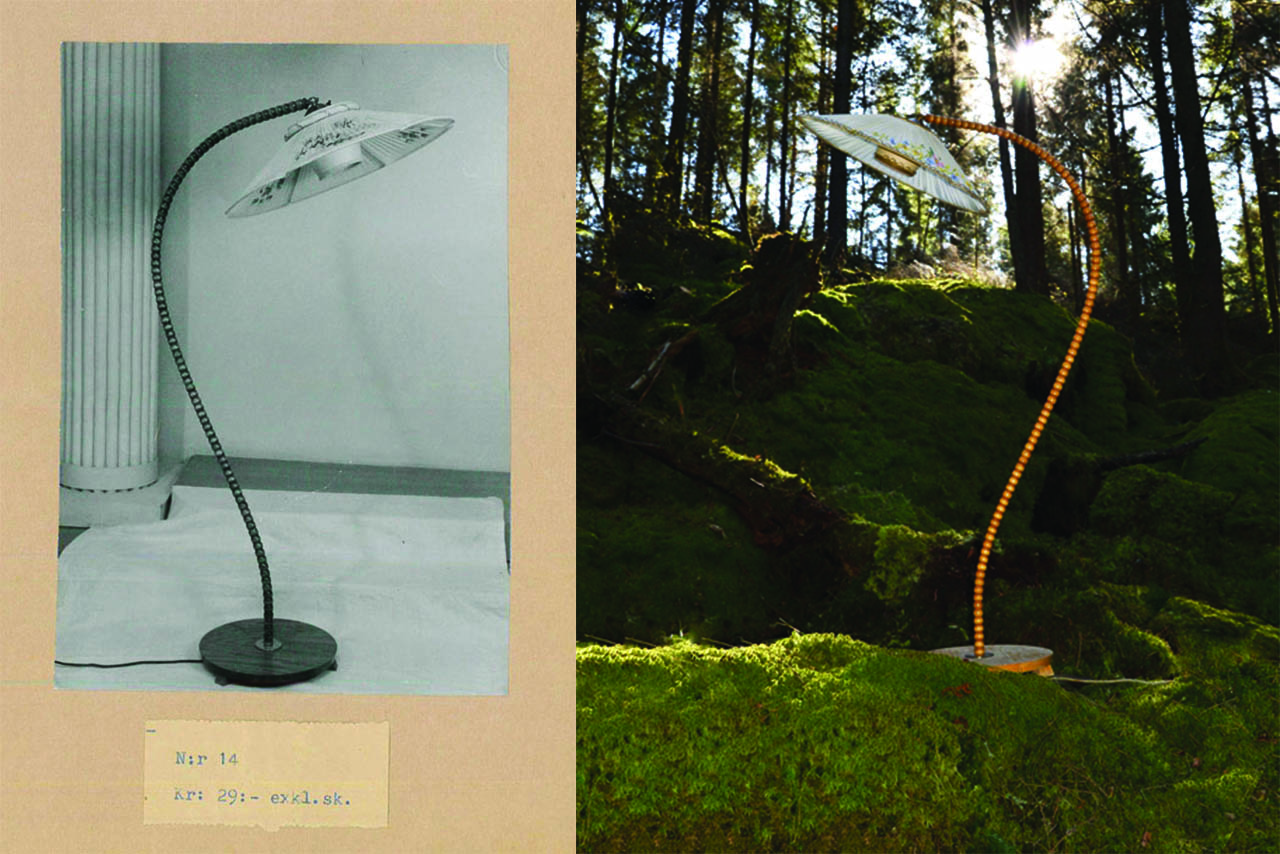
Bertil Svensson was never destined to take over the family farm. Being an inquisitive, open-minded person, he instead trained as an electrician. During the dark winter evenings on the farm, he would see his mother struggle with her handicrafts in a dimly lit room. In the year 1943, Bertil had a brilliant idea for a Christmas gift for his mum. He bought an 18.6 mm light-gauge conduit, a bit of cord, a lamp holder and a mains plug from his employer. He asked a local carpenter to turn him a birchwood lamp foot, and found a 60 cm lampshade at the local department store. And then he sat down to assemble his very first light fixture.
The result, a floor lamp in the shape of a question mark, was a big hit, brightening his mother’s crafts room on long, dark winter days.
“Doing needlework by the light of a floor lamp was not very common in those days,” Bertil said. “I didn’t spend a lot of money making that lamp, and when I saw what similar ones cost in the shops, I got the idea that maybe I could make a living making lamps.”
“That was my whole idea. I had no thought at all about organisation, sales technique or distribution.”
That would soon change. In 1945, Bertil Svensson teamed up with two childhood friends from Fagerhult. Helmer Andersson was a clever designer and production technician at Husqvarna. Harald Ulfenborg was a furniture manufacturer under the Ulferts brand. Together they started Fagerhults Lampindustri in an outbuilding on Bertil’s family farm in Fagerhult.
Bertil’s inventiveness, Helmer’s technological genius and Harald’s contacts in the furniture industry became the foundation of a highly successful home lighting company. It was not an easy time. Europe lay in tatters after the Second World War and it was hard to obtain materials. But thanks to its neutrality policy, Sweden was in fairly good shape, and soon its industry was running at full tilt.
In the beginning, Fagerhult focused on the home market, which was fuelled by the new Swedish welfare model. By autumn 1947, the company had outgrown the outbuilding and it moved to a newly built 98 m² factory. Since then that factory has been renovated and expanded more than 40 times, now boasting 55.000 m².
Because the factory began on such a small scale, and in such a small community, the first employees was Bertil’s friends and neighbours from the village of Fagerhult. For them, the most important thing was always the customer – to make someone’s everyday life better and more productive. Using new materials and solutions, Bertil had found a way to create added value for the user and profitability in his own production. An innovative approach that came to shape Fagerhult’s future activities and became a part of the company’s DNA.
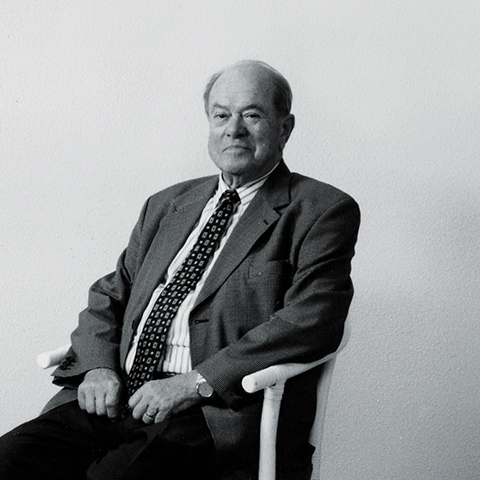 "I had no thought at all about organisation, sales technique or distribution. I got the idea that maybe I could make a living making lamps. That was my whole idea. ” Bertil Svensson, founder of Fagerhults Belysning AB
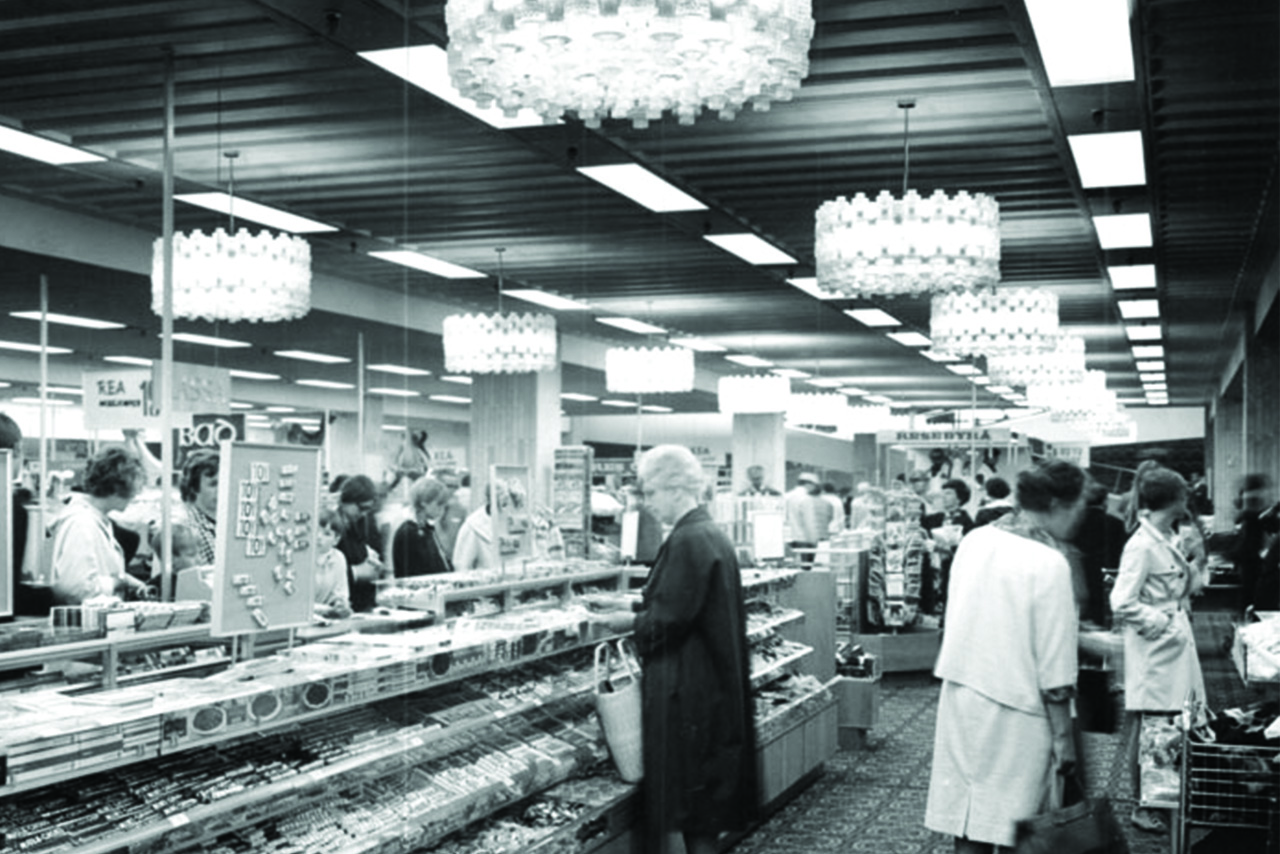
in 1948, a new light source entered the market– a fluorescent tube that produced a great amount of light at very low cost. Certain that this was the light solution of the future, he developed an entire collection of fluorescent-tube luminaires. A decade later, this paid off in Fagerhult’s first big prestigious order: 5.000 specially designed luminaires for the iconic functionalist National Tax Board building in Stockholm, “Skatteskrapan”. Fagerhult moved into the contract market, quickly becoming a key player in public interiors.
In the coming decades, the company grew steadily in the technical lighting field, although the focus remained on developing and manufacturing home lighting until well into the 1990s. By this time, Fagerhult’s signature traits of inquisitiveness and industriousness had resulted in several innovations that changed the lives of millions of people. The innovative plastic luminaire Fabian, of which more than 4 million were sold, and recessed downlights in the form of the popular Pleiad model, are just a few examples.
The courage to develop completely new luminaires based on relatively untested light sources is a shining trend throughout the years. When T5 fluorescent tubes were launched on the market, Fagerhult was one of the first companies to develop luminaires designed for the new light source. Fagerhult’s T5 luminaires combined the T5 light source, electronic controls and effective reflector materials that revolutionised the lighting industry and set a new standard for energy efficiency. When LED entered the scene 15 years later, the company followed the same path, generating as much light as possible, with no compromises.
In 1969, Bertil – who had been the company’s CEO since 1949 – was invited to take over all shares in the company. This was the beginning of an international expansion that occurred both organically and through acquisitions. In the coming decade, Fagerhult established sales offices in Denmark, Norway, the Netherlands and Germany. It also bought out its Swedish competitor Ateljé Lyktan. In 1984, Bertil left the office of CEO.
A few years later, Fagerhult was acquired by the Swedish Almedahl Group. In 1993 it was time for the next acquisition, when the investment company Latour, under the leadership of the Douglas family, took over all shares in the corporate group. Latour gave Fagerhult another long-term and committed owner – and the Douglas family have remained a major owner even after Fagerhult’s introduction to the Stockholm Stock Exchange in 1997. The operations were divided into three business units with their own manufacturing and development: Fagerhult Professional, Fagerhult Retail and Fagerhult Outdoor.
In September 2006, Bertil Svensson received an honorary doctorate at Jönköping University for his “distinguished life’s work as a national pioneer, entrepreneur and leading businessman in the lighting industry… and for important support to education and research in the lighting field”. Through the “Bertil & Britt Svensson Foundation for Lighting Technology” he supported new Swedish education in lighting technology, which would form the basis of the Lighting Academy.
Sadly, Bertil is no longer with us. In November 2006, Bertil left this world at the age of 86. However, his principle of providing people with the right light in the right place lives on – almost 75 years after the company was founded. Our head office is still located a stone’s throw from where our history began, in Fagerhult in rural west Sweden. We remain close to our roots, something we consider an advantage given that we now operate in almost 20 countries worldwide.
In 2020, Fagerhults Belysning AB that started out 75 years earlier as a three-man company, had become a wold-wide recognised brand with 650 employees still working on site in Fagerhult. All thanks to Bertil, his mother Elisabeth and her needlework basket.
Actualités

L'innovation à tous les niveaux - L'ingénierie de Wrapped au service de l'excellence
Comme sa durabilité n'est plus un choix mais une nécessité, l'innovation doit commencer par la question : Que se passerait-il si nous faisions les choses différemment? Pour l'équipe de R&D de Fagerhult, cette question est devenue l'étincelle derrière Wrapped, le premier luminaire suspendu au monde fabriqué en carton. Traditionnellement, les luminaires suspendus sont construits avec des corps métalliques, une méthode historique, sûre et conçue pour durer.. Mais l'équipe à l'origine de Wrapped a voulu explorer une autre voie. Ensemble, ils ont décidé de voir s'il était possible de créer un luminaire qui non seulement offrirait des performances de haut niveau, mais dont l'impact sur l'environnement serait réduit au minimum. Après un examen approfondi, le Solid board - un matériau en carton renouvelable et recyclé qui n'était utilisé auparavant que pour les composants dissimulés - joue désormais un rôle de premier plan. Wrapped est plus qu'un luminaire, c'est une exploration de la pensée visionnaire et de la créativité. Faute de solutions prêtes à l'emploi, l'équipe de conception a dû partir de zéro. Chaque élément, de la construction jusqu’au montage, a été analysé et le résultat est un luminaire à la fois qui se tient techniquement et qui est respectueux de l'environnement. Gallery: Wrapped details Le corps du luminaire est composé de 65 % de carton recyclé et se plie avec des découpes de haute précision qui s'emboîtent parfaitement. L'élégance en ingénierie Le corps de Wrapped est composé de deux parties principales : le corps intérieur et le corps extérieur, tous deux conçus pour agir en harmonie pour garantir la force et la stabilité. Le corps extérieur est maintenu en place par un étrier en aluminium 100 % recyclé (post-consommation), qui solidifie la forme en bloquant les plis en place. Ses embouts sont fabriqués en plastique 100 % recyclé (post-consommation) et s’enclipsent dans des découpes précises, fixant la structure sans avoir recours à des vis. La boîte de jonction est encliquetée et le driver est monté à l'aide de petits clips, fabriqués en plastique recyclé post-consommation. La carte LED est montée sur la lentille, protégée par un couvercle en carton compact, et l'ensemble du module d'éclairage est verrouillé à l'aide d'une grille. Il en résulte une structure sans couture et sans vis qui incarne un design judicieux. La conception dans un dessein Fredrik Beckius, ingénieur concepteur à la R&D, revient sur ce parcours :"Le défi consistait à travailler avec un matériau que nous n'avions jamais utilisé auparavant pour un luminaire suspendu. Nous ne pouvions pas monter les composants de la manière habituelle, nous avons donc dû trouver d'autres solutions".Martin Gustafsson, également ingénieur concepteur, ajoute :"Nous devions trouver un moyen de produire le luminaire de manière rentable, tant pour nous que pour nos fournisseurs. Chaque élément de la conception devait avoir plus d'une fonction". Ce double objectif est évident dans toute la conception de Wrapped. Il ne s'agit pas seulement d'esthétique ou de durabilité, mais aussi de génie technique et de rendre chaque pièce. importante. Citation Martin Gustafsson La durabilité sans compromis Wrapped est fabriqué à Fagerhult, Habo, à partir de matériaux recyclés et renouvelables d'origine locale. Il s'agit d'un produit issu de l'innovation suédoise, ancré dans l'héritage de conceptions durables antérieures telles que Multilume Re:Think et Kvisten. Contrairement à de nombreux produits respectueux de l'environnement, Wrapped manifeste une confiance tranquille et se contente d'indiquer que est durable. Avec des découpes de haute précision, une structure stable et des tests rigoureux tout au long du processus, Wrapped répond à toutes les normes de qualité sans compromettre son éthique environnementale.
Fagerhult présente le premier luminaire suspendu haut de gamme en carton au monde
Le nouveau luminaire Wrapped de Fagerhult est conçu et fabriqué en Suède. Il allie un éclairage haut de gamme à une grande efficacité et un faible poids, tout en étant le luminaire haut de gamme le plus respectueux du climat à ce jour. Le corps du luminaire est fabriqué en carton organique et recyclé, dont l'impact sur le climat est 89 % plus faible par kg que celui de l’aluminium. Les quelques pièces en plastique et en métal sont également en matériaux recyclés. Le résultat est un luminaire suspendu dont l'impact sur l'environnement est réduit au minimum, sans compromis sur la qualité de la lumière ou le design. En utilisant Solid board, nous repoussons un peu plus loin l'idée qu'un luminaire suspendu doit être fabriqué en aluminium. Nous nous sommes simplement posé la question : Pouvons-nous utiliser un autre matériau renouvelable et recyclé qui fait partie d'une infrastructure circulaire établie ?" explique Christer Liljegren, chef de produit chez Fagerhult. La durabilité au service de l'accessibilité Wrapped associe des performances d'éclairage de premier ordre à un prix avantageux - et met des solutions d'éclairage durables à la disposition d'un public plus large. Le choix d'un matériau plus léger a également permis d'atteindre un poids total de 1,6 kg (luminaire suspendu 900 mm). "Je pense que les installateurs apprécieront Wrapped autant que nous. Il est étonnamment léger et facile à manipuler", déclare Christer Liljegren. Le lancement comprend le luminaire suspendu Wrapped de 900 mm. La faible quantité de matériau en fait un choix vraiment durable, car il est aussi performant qu'un luminaire général de 1200 mm dans de nombreuses applications. Il est disponible avec la grille Beta Opti et a une distribution lumineuse directe et indirecte de 50/50. La famille de produits sera complétée par d'autres produits en 2026. Etre dignes de notre héritage d’innovation durable Wrapped s'inscrit dans la continuité du travail innovant de Fagerhult avec des matériaux durables, après le Multilume Re:Think (également fabriqué en Solid board) et le luminaire en bois Kvisten. "Wrapped incarne notre idée d’un éclairage light for a brighter tomorrow - en combinant un éclairage haut de gamme avec la durabilité à un niveau accessible", déclare Paula Backman, directrice des produits et du marketing chez Fagerhult.